

UAE, India set $200bn trade target as leaders deepen strategic partnership
President Sheikh Mohamed bin Zayed, PM Modi agree to double trade and accelerate investment flows

DUBAI/NEW DELHI – At the invitation of Indian Prime Minister Narendra Modi, President His Highness Sheikh Mohamed bin Zayed Al Nahyan paid an official visit to India on Monday, marking his fifth visit to the country in the past decade and his third since assuming office as President of the UAE.
The visit underscored the rapid evolution of UAE–India ties under their Comprehensive Strategic Partnership and Comprehensive Economic Partnership Agreement.
Talks in New Delhi focused on expanding cooperation across trade, investment, energy, technology, defence and people-to-people links, reflecting the growing depth and breadth of the bilateral relationship. Both leaders reviewed progress achieved over the past ten years and outlined priorities for the next phase of engagement, anchored in shared economic ambitions and regional stability.
Strategic UAE-India partnership
Prime Minister Modi and President Sheikh Mohamed bin Zayed reviewed the full scope of bilateral cooperation, agreeing that the Comprehensive Strategic Partnership has continued to strengthen steadily. They welcomed recent high-level visits by His Highness Sheikh Khaled bin Mohamed bin Zayed Al Nahyan, Crown Prince of Abu Dhabi, and His Highness Sheikh Hamdan bin Mohammed bin Rashid Al Maktoum, Crown Prince of Dubai, Deputy Prime Minister and Minister of Defence, describing them as evidence of generational continuity in the relationship.
The leaders endorsed outcomes from the 13th High-Level Task Force on Investments held in September 2025, alongside the 16th India-UAE Joint Commission Meeting and the fifth Strategic Dialogue convened in December 2025. These mechanisms were recognised as central to advancing cooperation across priority sectors and ensuring alignment at both policy and implementation levels.
Trade momentum
Economic ties featured prominently during the discussions, with both sides noting the strong impact of the Comprehensive Economic Partnership Agreement signed in 2022. Bilateral trade reached US$100 billion in the 2024-25 financial year, reflecting robust growth across goods, services and investment flows.
Building on this momentum, the two leaders agreed to set an ambitious target of doubling bilateral trade to US$200 billion by 2032. They directed their teams to intensify efforts to connect Micro, Small and Medium Enterprises in both countries and accelerate initiatives such as Bharat Mart, the Virtual Trade Corridor and the Bharat–Africa Setu. These platforms are expected to expand market access for MSME products across the Middle East, West Asia, Africa and Eurasia.
Investment links
The leaders expressed satisfaction with the Bilateral Investment Treaty signed in 2024, which has strengthened investor confidence and facilitated capital flows across multiple sectors. Discussions also covered a potential UAE partnership in developing the Dholera Special Investment Region in Gujarat, envisioned as a hub for advanced infrastructure and industrial growth.
Proposed areas of collaboration include the development of an international airport, a pilot training school, aircraft maintenance, repair and overhaul facilities, a greenfield port, smart urban infrastructure, rail connectivity and integrated energy systems. Prime Minister Modi invited UAE sovereign wealth funds to consider participating in the second National Investment and Infrastructure Fund, scheduled for launch in 2026, following the success of its first fund.
Both leaders welcomed the establishment of DP World and First Abu Dhabi Bank branches in GIFT City, reinforcing its emergence as a global financial centre. FAB’s presence is expected to strengthen financial connectivity between Indian corporates and investors and markets across the GCC and wider MENA region.
Energy cooperation
Energy cooperation was highlighted as a core pillar of the partnership, with the leaders underscoring the UAE’s role in supporting India’s energy security. They welcomed the signing of a 10-year liquefied natural gas supply agreement between ADNOC Gas and Hindustan Petroleum Corporation Limited, under which 0.5 million tonnes of LNG will be supplied annually beginning in 2028.
The enactment of India’s Sustainable Harnessing and Advancement of Nuclear Energy for Transforming India law was also noted as opening new avenues for civil nuclear cooperation. Both sides agreed to explore collaboration in advanced nuclear technologies, including large reactors and Small Modular Reactors, alongside cooperation in plant operations, maintenance and nuclear safety.
Technology drive
The two leaders agreed to deepen cooperation in science, technology and innovation, particularly in artificial intelligence and emerging technologies. They welcomed plans to collaborate on establishing a supercomputing cluster in India and agreed to explore cooperation in developing data centres.
Discussions also covered the possibility of establishing Digital Embassies between the two countries under mutually recognised sovereignty arrangements. President Sheikh Mohamed bin Zayed expressed support for the AI Impact Summit scheduled to be hosted in India in February 2026, highlighting the role of artificial intelligence in driving sustainable development and economic growth.
Space cooperation featured prominently, with both sides welcoming a joint initiative aimed at commercialising the sector through advances in space sciences and technologies. The initiative seeks to create an integrated space ecosystem, enabling joint missions, expanding global commercial services, supporting start-ups and generating high-skilled employment.
Security dialogue
Defence and security cooperation was reaffirmed as a central element of the Comprehensive Strategic Partnership. The leaders welcomed the momentum generated by recent exchanges of visits by service chiefs and commanders of the armed forces, as well as the successful conduct of bilateral military exercises.
They also welcomed the signing of a Letter of Intent towards concluding a Strategic Defence Partnership, signalling intent to expand collaboration across defence industries, training and operational engagement. Both sides reiterated their unequivocal condemnation of terrorism in all its forms and agreed to continue cooperation within the framework of the Financial Action Task Force to counter terror financing and strengthen anti-money laundering measures.
The leaders reaffirmed their commitment to the India-Middle East–Europe Corridor, launched during the G20 Summit in Delhi in 2023, describing it as a project of strategic importance for enhancing trade and energy flows between India, the Middle East and Europe.
Cultural and people-to-people ties were also emphasised, with India welcoming the UAE’s decision to provide artefacts for the National Maritime Heritage Complex at Lothal and the agreement to establish a House of India in Abu Dhabi. Education cooperation was highlighted through expanded university linkages, student exchanges and plans to integrate India’s Digilocker with UAE platforms for academic credential verification.
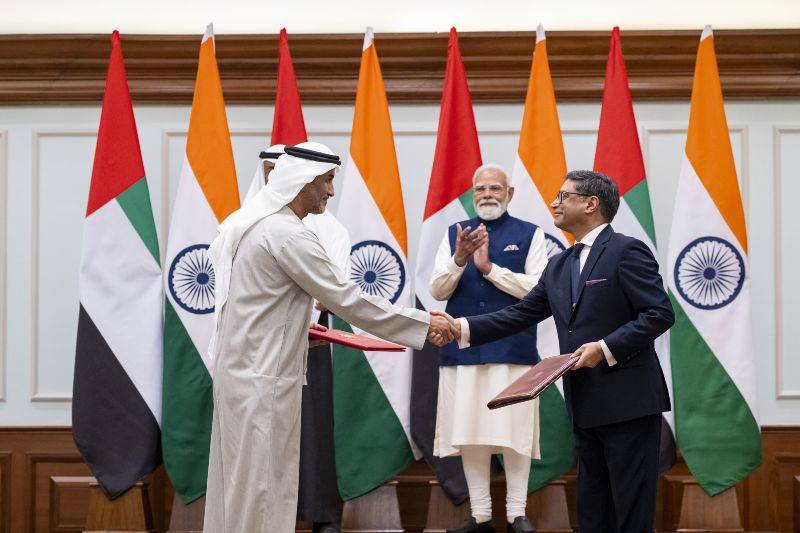
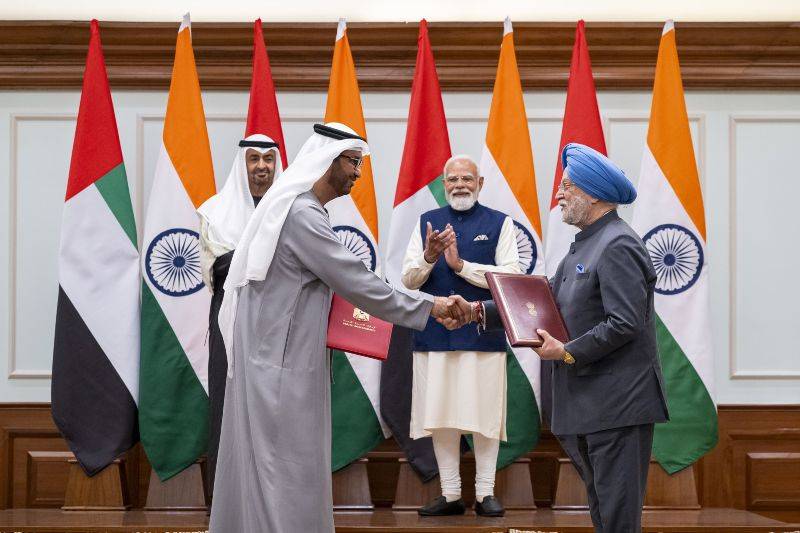
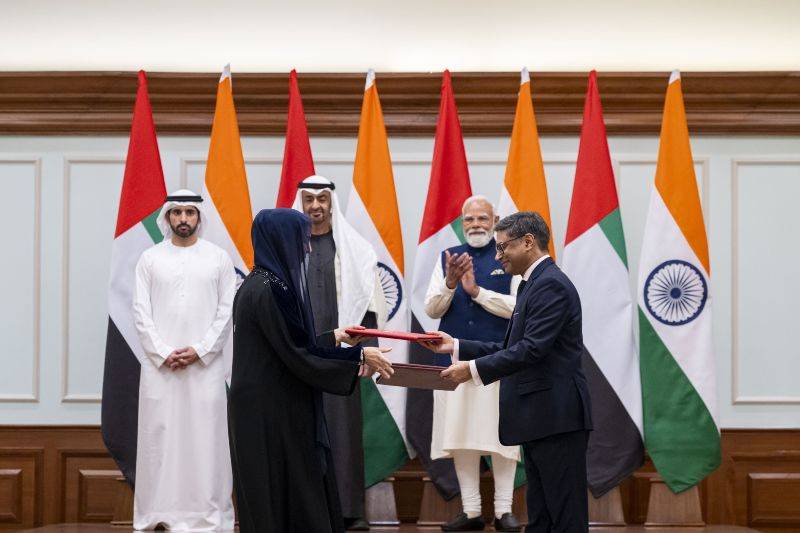
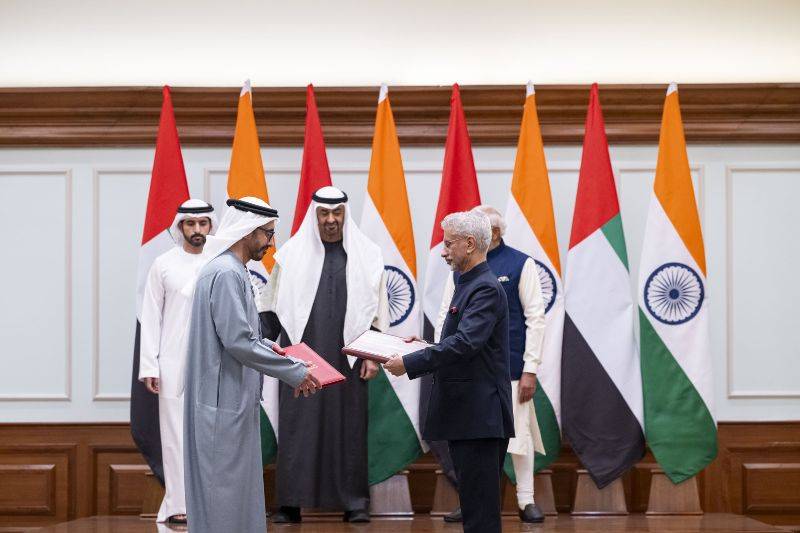
During the visit, the two leaders also witnessed the exchange of several agreements and memoranda covering defence, space, energy, food safety and investment cooperation, reinforcing the institutional framework underpinning the expanding UAE-India partnership.